What Are Hip Flexors, and Does Sitting Make Them Tight?
Sitting gets the blame for tight hip flexors. What the research really shows, a simple bed-edge test, and a short routine to open and strengthen the hip.
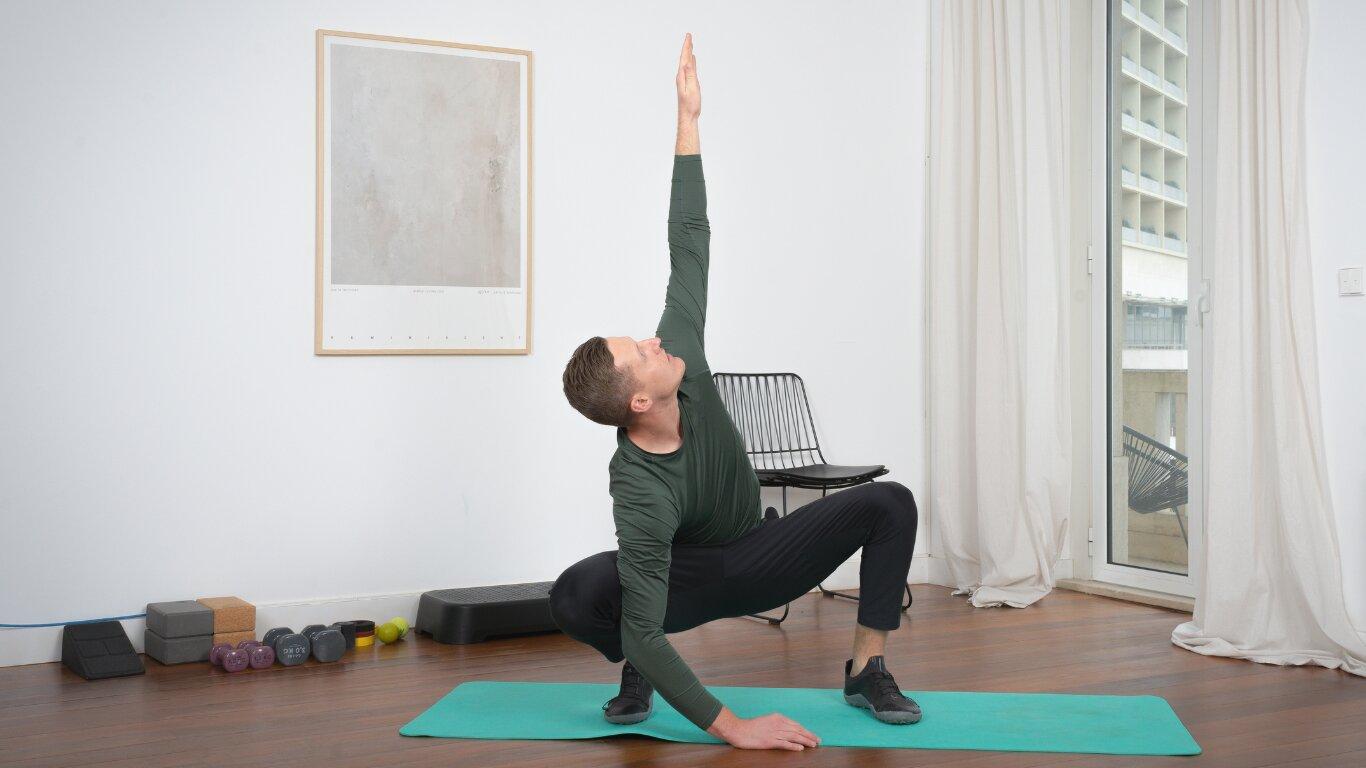
In shortYour hip flexors are the muscles at the front of the hip that bring your thigh and trunk closer together. Lots of sitting with little movement is linked to a bit less range at the front of the hip, but the evidence is thinner than most articles claim. Test first, then stretch, strengthen and retest.
You stand up after a long meeting and the front of your hips needs a moment to unfold. The first few steps are short and stiff. Ask the internet why, and the answer comes back fast: sitting has made your hip flexors tight, so stretch them.
That's partly true. The research is more modest than the headlines, and the fix is a bit more than "stretch more". Here's what your hip flexors are, what sitting really does to them, a test you can do on the edge of your bed, and the short routine we use at Move More Human.
What are your hip flexors?
Your hip flexors are the group of muscles at the front of your hip that bring your thigh and your trunk closer together. You use them every time you lift a knee to climb stairs, march, or sit up from lying down. The main ones are the iliopsoas, deep in the front of the hip, and the rectus femoris, one of your quads. A smaller muscle on the outside of the hip, the tensor fasciae latae, helps too.
Their opposite movement is hip extension: your leg moving behind your body, as it does at the end of every walking stride. That's the range people mean when they say their hip flexors are tight. It's also the range a chair never asks for.
Does sitting really make your hip flexors tight?
Probably a little, but the link is with sitting plus not moving, and it's smaller than most articles suggest. The most direct evidence is a 2020 study by Boukabache and colleagues. They measured how far the hip could extend in 144 adults and asked about their sitting and activity. People who were active and sat less than 4 hours a day had about 6 degrees more hip extension than people who sat more than 7 hours a day and did less than 150 minutes of activity a week.
Six degrees is real, but it isn't dramatic. This kind of study also shows a link, not a cause. It can't tell whether the sitting did it, or the lack of movement that came with it, and the authors call for more research. So the honest answer is this: a sitting-heavy, low-movement life is linked to a little less hip extension. Sitting alone hasn't been shown to shorten anything.
Is a tight feeling the same as a short muscle?
Not always. How tight a muscle feels and how long it actually is are two different things. A 2010 review by Weppler and Magnusson looked at why people gain range when they stretch. A muscle does lengthen during a stretch, but that change fades. Most of the extra range people gain from one session, or from a 3 to 8 week stretching programme, seems to come from tolerating the stretch better, not from a longer muscle.
That matters for your hips. The pulled, stiff feeling after a long day can be your body asking for movement as much as a sign of a short muscle. Our article on why stretching alone doesn't stick goes deeper into this. The practical point: test what your hips can actually do, instead of going by feel.
How do I test my hip flexors at home?
Use a home version of the Thomas test, a common check for hip flexor length. It only works if your lower back stays still. A 2016 study by Vigotsky and colleagues found the test was a poor measure of hip extension unless the tilt of the pelvis was controlled. A 2024 study by Eimiller and colleagues found consistent results when it was. So the knee hug in step two is the part that matters.
- 01Sit on the very end of a sturdy bed or table, so about half of your thighs are off the edge.
- 02Hug one knee to your chest and roll onto your back. Pull the knee in until your lower back lies flat. Keep it there for the whole test.
- 03Let the other leg hang off the edge, fully relaxed. Don't push it down.
- 04Check the hanging leg: does the back of the thigh rest on the surface, or float above it? Ask someone to take a photo from the side.
- 05Swap legs and compare.
If the thigh floats above the surface while your back stays flat, that hip can't reach a straight line with your body. That's the range you're working on. There's no perfect score to chase. Your own photo, and the difference between your left and right side, is what you'll compare against.
What do I do about tight hip flexors?
Release the front of the hip, then build strength in the new range, and get out of the chair more often. This is the Human Mechanics Method by Move More Human: Test, Release, Strengthen, Retest. The drills take about ten minutes.
- 01Half-kneeling hip flexor stretch, 2 rounds of 30 to 45 seconds per side. One knee down on a cushion, the other foot in front. Before you lean, tuck your tailbone under and squeeze the glute of the down leg. Then shift forward only a few centimetres. If your lower back arches, you've gone too far.
- 02Standing leg reach back, 10 slow reps per side. Hold a wall, stand tall, squeeze one glute and move that leg behind you without arching your lower back. Pause for two seconds at the end.
- 03Glute bridge, 3 rounds of 10 slow reps. On your back, knees bent, push through your heels until knees, hips and shoulders line up. Hold two seconds at the top. Feel it in your glutes, not your lower back.
- 04Split squat, 2 rounds of 6 to 8 per side. Long stance, back heel up. Lower the back knee slowly toward the floor with your trunk tall. Holding a chair is fine.
Why this mix? Both passive stretches and active ones can help. In a 2004 randomised trial by Winters and colleagues, 33 young adults with limited hip extension did either passive or active stretches at home. Both groups gained range over six weeks, with no difference between them. In our sessions we then add strength, so you can control the new range and not just reach it.
And there's the chair itself. Break up long sits with a short walk. Every stride takes the hip briefly behind you, into exactly the range a chair leaves out. Our movement snacks article has ideas that fit into a workday.
How long does it take to see a change?
Expect slow, modest change, and judge it by the retest. In a 2003 trial by Kerrigan and colleagues, 96 healthy older adults stretched their hip flexors twice a day for ten weeks. Their hip extension improved from about 6.1 to 7.7 degrees on average, while a group that stretched their shoulders saw no change. Their hip extension while walking showed a trend in the same direction. Small, but it moved.
Do the routine most days and retest after two weeks. Same bed, same knee hug, same photo angle. A thigh that now rests lower is real progress. Day-to-day wobble is normal, so look at the trend, not one morning.
When to get it checked
Stiffness at the front of the hip after a long sit usually responds well to movement. Some things are different: sharp or pinching pain in the groin, a hip that catches or locks, pain that wakes you at night, numbness or tingling down the leg, swelling, or pain after a fall or injury. If any of those apply, stop and see a qualified clinician first. Move More Human teaches movement, not medicine.
Common questions
- Can tight hip flexors cause lower back pain?
- Back pain has many causes, and the research doesn't let you blame the hip flexors on their own. It's still worth testing your hips, and our article on a stiff lower back from sitting shows how. If back pain keeps coming back or comes with any of the red flags above, get it assessed.
- Should I stretch my hip flexors every day?
- A short session most days works better than a long one once a week. In the trials above, people stretched at home for six to ten weeks, in one case twice a day. Pair the stretch with a strength drill, and keep it gentle: you should feel a stretch, never a pinch.
- Does a standing desk help tight hip flexors?
- Standing takes your hips out of the bent sitting position, but standing still is still standing still. What the research links to more hip extension is sitting less and moving more, together. Use a standing desk as one more way to change position, and keep walking breaks in your day.
- What is the Thomas test?
- It's a common check for hip flexor length. You lie at the end of a table, hug one knee to your chest and let the other leg hang. If the hanging thigh can't rest on the table while your lower back stays flat, the front of that hip is limiting extension. Keeping the lower back flat is what makes the result trustworthy.
Sources
- Boukabache A, Preece SJ, Brookes N. Prolonged sitting and physical inactivity are associated with limited hip extension: A cross-sectional study. Musculoskeletal Science and Practice, 2020.
- Weppler CH, Magnusson SP. Increasing muscle extensibility: a matter of increasing length or modifying sensation? Physical Therapy, 2010.
- Vigotsky AD, et al. The modified Thomas test is not a valid measure of hip extension unless pelvic tilt is controlled. PeerJ, 2016.
- Eimiller K, et al. Reliability of Goniometric Techniques for Measuring Hip Flexor Length Using the Modified Thomas Test. International Journal of Sports Physical Therapy, 2024.
- Winters MV, et al. Passive versus active stretching of hip flexor muscles in subjects with limited hip extension: a randomized clinical trial. Physical Therapy, 2004.
- Kerrigan DC, et al. Effect of a hip flexor-stretching program on gait in the elderly. Archives of Physical Medicine and Rehabilitation, 2003.
By Daniël Stegehuis
Move with us,
live and free.
Head to Toe: three free live sessions on Zoom, one body region at a time.
/ Head to Toe: free live series
- Sat 28 NovBuild Your Foundation
15:00 Amsterdam / 9:00 New York / 60 min / Live on Zoom / Free
Pick one session or all three
You get the Zoom links by email, plus a PDF guide after each session. Want occasional movement tips too? Tick the box on the form.
More / From the Journal

How to Check Your Own Mobility at Home (a 10-Minute Self-Test)
Six simple checks, head to toe, with a wall, a chair and a tape measure. What each one tells you, what it doesn't, and how to retest so you see real change.
Nov 20, 2026

How to Fix Rounded Shoulders From Sitting at a Desk
Rounded shoulders from desk work can change. What the research shows, a simple floor test, and a short routine to open the chest and strengthen the upper back.
Nov 19, 2026